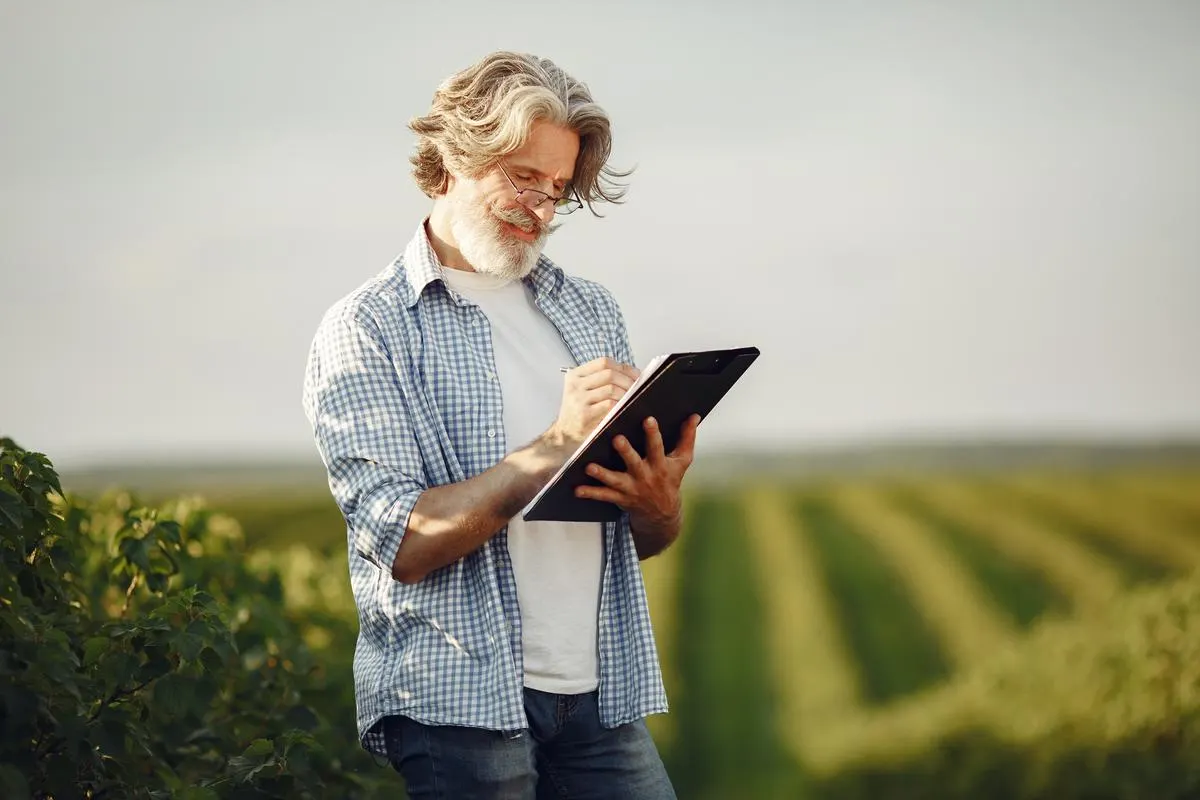

Herdade dos Sobreiros (real case — data altered under NDA), a farm in the Alentejo with 450 hectares dedicated to olive groves, vineyards and horticulture, managed irrigation by intuition and experience — the foreman decided when and how much to irrigate based on the visual appearance of the plants and the weather forecast. Harvests were recorded in notebooks, without formal traceability. When we implemented IoT soil moisture sensors, a harvest management app and digital traceability from field to distribution, water consumption dropped 40%, olive grove productivity rose 22% and the farm obtained traceability certification that opened the door to the premium export market.
The Scenario Before: Farming by Instinct
The Alentejo is Portugal's most important agricultural region — and also the most exposed to water stress. With increasingly longer and hotter summers, and the cost of water rising year after year, irrigation efficiency ceased to be an option and became a matter of survival.
At Herdade dos Sobreiros, irrigation was managed by Manuel, foreman for 25 years, based on his experience. Manuel would walk the fields each morning, observe the state of the plants, check the weather forecast on his phone and decide which sectors to irrigate and for how long. It was a system that worked — when Manuel was present. When he was ill, on holiday or simply when the area to cover was too large for one person, the quality of irrigation decisions deteriorated.
The fundamental problem was that Manuel made decisions based on what he could see on the surface — but the actual moisture in the soil, in the root zone, was invisible to the naked eye. Soil can appear dry on the surface yet be moist at 30 cm depth. Or the opposite: appear moist after light rain, but dry where the roots actually need water. Without objective data, irrigation was either insufficient (water stress, lost production) or excessive (wasted water and energy, and risk of fungal diseases).
Harvest management was equally analogue. Each harvest was recorded in a notebook: date, plot, estimated quantity (weighed on a floor scale), and destination (own mill, client X, cooperative). There was no record of production costs per plot, nor yield per hectare, nor product traceability from field to end client.
When a German importer asked the farm whether its olive oil had certifiable traceability — "can you prove that this olive oil comes from that plot, harvested on that date, processed at that mill?" — the answer was no. The premium export deal was left on the table. And with it, a margin 60% higher than selling on the domestic market.
The Numbers Behind the Problem
• Water consumption: 280,000 m³/year — with no efficiency measurement per plot.
• Zero sensors — all irrigation decisions based on visual observation.
• Olive grove productivity: 4.2 tonnes/hectare — below the estimated potential of 5.5 tonnes/hectare for the variety.
• Traceability: non-existent — impossible to certify origin for premium markets.
• Production cost per plot: unknown — only the average cost of the entire farm was calculated.
• Paper records: 100% — vulnerable to loss, damage and illegibility.
The Solution: Affordable Precision Agriculture
Phase 1 — IoT Sensors and Smart Irrigation (Weeks 1–8)
We installed 48 soil moisture sensors distributed across 12 plots — 4 sensors per plot, at different depths (15 cm, 30 cm, 45 cm and 60 cm). The sensors measure volumetric soil moisture every 15 minutes and transmit the data via LoRaWAN network to a central gateway, which sends it to the cloud.
We added a complete weather station on the farm: temperature, relative humidity, wind speed and direction, solar radiation and rainfall. These data, combined with calculated evapotranspiration, allow the system to estimate with precision how much water each plot needs — not based on visual appearance, but on the actual physics of the soil and atmosphere.
The irrigation dashboard shows, in real time, the status of each plot: current moisture level at each depth, comparison with the ideal range for the crop (different for olive trees, vines and vegetables), and irrigation recommendation — how long and at what flow rate. Manuel went from "deciding by intuition" to "validating the system's recommendation" — retaining the final decision, but now informed by objective data.
We integrated the system with the existing irrigation solenoid valves. When Manuel approves the recommendation, irrigation starts and stops automatically. He can do this from his phone, without leaving the office — or configure the system to irrigate automatically when moisture drops below a defined threshold.
Do you manage a farm without objective soil and climate data?
We implement IoT sensors, smart irrigation and digital harvest management — affordable precision agriculture.
See Intelligent Automation →Phase 2 — Harvest Management App (Weeks 6–12)
We developed a mobile application where workers record all crop operations: planting, pruning, phytosanitary treatments, fertilisation, harvesting and transport. Each record includes date, plot, operation, products used (with batch and quantity), operator and observations.
At harvest, the system records the quantity per plot (connected to a Bluetooth digital scale), the date and time, the destination (mill, cold storage, direct client) and the conditions — for example, olive maturity level or grape Brix degree. These data feed the traceability module.
The system automatically calculates the production cost per plot: labour (recorded hours × cost/hour), inputs (fertilisers, phytopharmaceuticals, water), machinery (tractor hours × cost/hour) and apportioned fixed costs. For the first time, the owner could see which plots were profitable and which needed adjustments — whether in the cultivated variety, the inputs used or the production technique.
Phase 3 — Traceability from Field to Table (Weeks 10–14)
We created a complete traceability system that links each final product to its origin. For olive oil: source plot → harvest date → olive batch → mill → oil batch → bottle → client. For grapes: plot → harvest → winery → wine batch → bottle. For vegetables: plot → harvest → crate → distributor.
Each bottle of olive oil can have a QR code that the end consumer scans on their phone and sees: the plot where the olives were harvested (with photograph and GPS location), the harvest date, the mill where it was extracted and the physico-chemical analyses of the batch. This transparency is valued by premium consumers and is a requirement for several export markets.
For certification, the system automatically generates the reports required by standards such as GlobalGAP and integrated production — treatment records, safety intervals, soil and water analyses, and digital field notebook. Certification that previously required weeks of document preparation became a simplified process.
The Results: Before vs. After
After 12 months of operation with the full system:
• Water consumption: from 280,000 m³/year to 168,000 m³/year (−40%). Savings of €33,600 in water and pumping energy.
• Olive grove productivity: from 4.2 to 5.1 tonnes/hectare (+22%). Optimised irrigation eliminated water stress during critical fruit growth phases.
• Traceability: 100% — from field to bottle. The farm obtained GlobalGAP certification and access to premium export markets.
• Production cost per plot: full visibility — allowed identification of 3 vegetable plots with negative margins and their reconversion.
• New export contracts: 2 importers (Germany and Denmark) for traceable premium olive oil, with a margin 60% above the domestic market.
• Audit preparation time: from 3 weeks to 2 days.
• Early problem detection: the system alerted to a leak in the irrigation system that was wasting 800 litres/hour — detected through anomalous consumption in one plot.
The Financial Impact
The total investment — sensors, weather station, LoRaWAN gateway, app, traceability platform and training — was €31,000. First-year return: €33,600 in water savings, €48,000 in additional olive production, and estimated revenue of €85,000 from new premium export contracts. The first-year ROI exceeded 400%.
Manuel, sceptical at first, became the system's greatest advocate: "It didn't replace me — it gave me eyes I didn't have. Now I can see what's happening beneath the ground, and that changes everything."
Lessons for Other Farmers
1. IoT sensors are not future technology — they are present technology. Costs have fallen 80% in the last 5 years. A soil moisture sensor that cost €300 now costs €45. The LoRaWAN network covers kilometres with minimal energy consumption. The barrier is no longer cost — it is knowledge.
2. Saving water is saving money — and the planet. In water-stressed regions like the Alentejo, every cubic metre of water saved is doubly valuable: it reduces operational costs and contributes to the long-term sustainability of the farm.
3. Traceability opens markets. The premium consumer wants to know where their food and drink comes from. Digital traceability is not bureaucracy — it is a commercial advantage that provides access to market segments with significantly higher margins.
Conclusion
Precision agriculture is not exclusive to large-scale operations with millions in investment. Herdade dos Sobreiros demonstrated that, with an affordable investment and a phased implementation, any farm can benefit from objective data to make better decisions. The combination of IoT, digital management and traceability transformed a traditional farm into a modern, efficient operation competitive in the world's most demanding markets.
Want to implement IoT on your farm?
Soil sensors, smart irrigation and digital traceability — precision agriculture within your reach.
Talk to us →